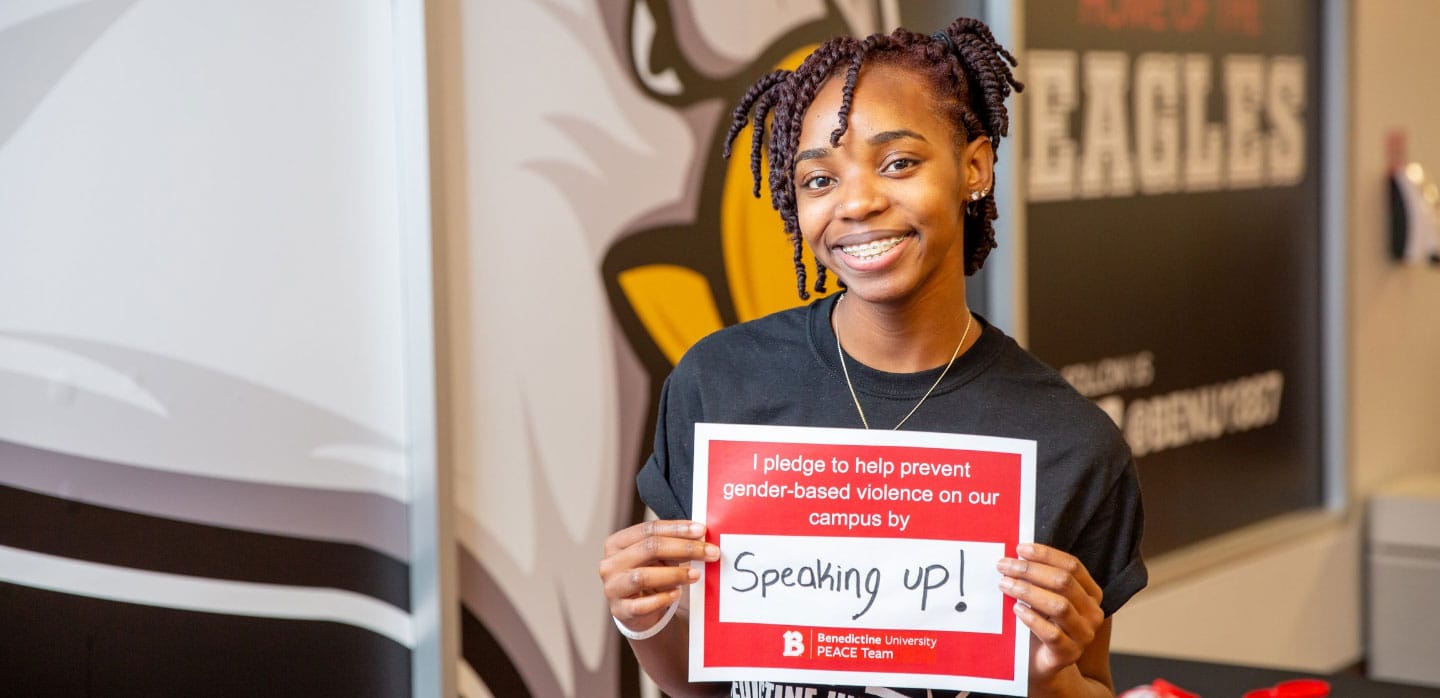
Welcome to the Benedictine University PEACE (Promoting Empowerment and Community Engagement) Team page! The PEACE team began on campus in October 2016 when the University received the Violence Against Women Act Campus Grant from the Department of Justice, Office on Violence Against Women. Starting with a small core team of staff, we have expanded to include faculty and staff from across the University, as well as students and community partners. The responsibility of the PEACE team is to promote messages of Benedictine University violence prevention in connection with our University values and hallmarks, advise on policies and procedures that reflect best practices, and current legislation regarding incidents of gender-based violence (sexual assault, domestic violence, dating violence and stalking), and coordinate training and communication amongst Title IX, law enforcement, victim services and the larger Benedictine community.
It’s On Us Benedictine University!
It’s on ALL of us to prevent gender-based violence and create a safe and welcoming environment for everyone.
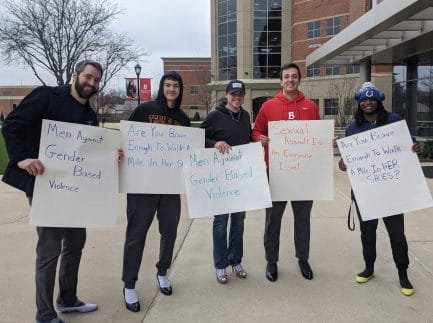
The PEACE team launched this campaign on our campus in January 2018 when three student leaders approached staff to find out how they can get more involved to educate their fellow students about violence prevention and survivor support on campus. They organized a seminar to talk about consent, bystander intervention and survivor support; created a poster campaign; and helped direct our first It’s On Us video. This passion from students led to our Prevention Peer Educator program and now we share this video and campaign with all of our Freshmen students. It is grounded in our University mission and hallmarks that guide us to welcome all to campus, value every member of our community and show each other love by treating everyone on our campus with dignity and respect. It’s on ALL of us to prevent gender-based violence and create a safe and welcoming environment for everyone.
All new freshmen and transfer students at Benedictine University complete a training called BenU Healthy Relationships: Eagles Step Up. This session provides a guide to build healthy relationships among each other, demonstrates how we practice our values by engaging in violence prevention and calls all of our students to be active bystanders.
Bystander Intervention
All students are invited to participate in Bringing in the Bystander, a training by Soteria Solutions, a prevention workshop to create a community of responsibility.
Awareness Months
Throughout the year, we host programming to promote healthy relationships, consent and bystander intervention with specific events taking place during Domestic Violence Awareness Month (October), Stalking Awareness Month (January) and Sexual Assault Awareness Month (April).
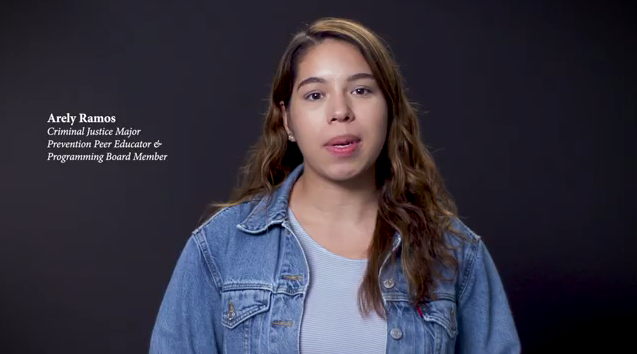
PEACE Prevention Peer Educators
Peer educators gain professional development practicing skills of leadership, public speaking and networking while also serving their community. Presentation topics include sexual assault, domestic violence, dating violence and stalking as well as bystander intervention, consent, healthy relationships and resource referral.
If you have experienced any form of gender-based violence (including sexual assault, domestic violence, dating violence, or stalking) there are resources that can help. Below are all of the Resources on and off campus. We also have Resource and Referral Guides to show what options survivors have for reporting and confidential support.
Counseling Center
Whether you are currently in an abusive relationship, are a survivor, or just want to talk about healthy relationships, boundaries, or consent in a confidential and safe space, the Benedictine University Counseling Center is available to support you. We offer free, confidential counseling services for our students. To schedule a virtual appointment, call us at (630) 829-1800 or find more information here.
YMCA of Metropolitan Chicago
2055 E Army Trail Road, #140 Addison, IL 60101 (630) 790-6600
Individual and Group counseling for adults and children
Orders of Protection
Legal and court advocacy
Safety Planning
Case management/Connection to resources
Prevention Education
Arab American Family Services
7000 W. 111th St. Worth, IL 60482 (708) 599-2237 aafsil.org Hotline: (708) 945-7600
The AAFS Speak Up Program offers:
24-Hour Hotline
Safety Planning
Crisis Management
Individual and Group Counseling
Prevention Training
Legal and Court Advocacy
Employment Assistance
Education Assistance
Resource Connection and Case Management
Arab American Family Services
Individuals who have experienced Gender-Based Violence have a right to accommodations to assist them to feeling safe and being able to continue their educational experience. Examples of accommodations include:
Housing adjustments
Switching class schedule
Academic accommodations
To discuss what accommodations may be right for you, contact Taffie Duzan, Associate Director of Disability Services and Learning Specialist, at [email protected]. Visit the Academic Support Center for more information.
Prevention Peer Educators
Our Prevention Peer Educators work with our PEACE team to provide violence prevention training and programming to the campus community. They are also available for peer support to help students understand their rights and options for services and reporting gender-based violence on and off campus. Find out more about our current Prevention Peer Educators here.
The Trevor Project
The Trevor Project is a 24/7 crisis intervention and suicide prevention hotline for LGBTQ+ youth. The hotline number is (866) 488-7386 and their website is www.thetrevorproject.org.
Reporting Options
It is always your right to decide whether or not you report an incident(s) of gender-based violence to University Police or University Officials. Survivors or bystanders who report, in good faith, any of these incidents will NOT receive a sanction under the Student Code of Conduct as per the Good Samaritan Exemption. The safety of our students and community members is our top priority.
Title IX
Individuals can report gender-based violence that occurs on campus to our Title IX Coordinator by contacting them directly, filing an anonymous report on the web page, or reporting to an Official With Authority. View our full Title IX Policy and more information here.
Dr. Julie Dockery Title IX Coordinator Associate Vice President of Academic Affairs and Student Life Goodwin Hall 483 5700 College Rd., Lisle, IL 60532 (630) 829-2172 [email protected]
Campus Security Authorities (CSAs) are select members of the Benedictine University community who are responsible for reporting crimes on or near campus that are reported to them. Find a list of Campus Security Authorities for the Lisle and Mesa Campus here.
Student Conduct
Additional reporting options of gender-based violence can be reported through our Student Conduct process. For more information or to file a report, contact Marco Masini, Dean of Students at (630) 829-6006 or [email protected].
CARE Team
Members of our Benedictine Community may also complete a Campus Response Evaluation (CARE) Team referral if they are concerned about the well-being or safety of a student, faculty, staff member, or guest on campus. More information and the CARE Team Referral Form can be found here.
How to Support a Survivor
If someone comes to you to report an incident of gender based violence (sexual assault, domestic violence, dating violence, or stalking) it generally means that you are someone that they trust. How you respond to their disclosure can have a significant impact on how they heal and view future relationships. Benedictine University cares about every member of our community and has resources available to both you and the survivor.
Here are some tips to guide you as you support the survivor:
Listen and believe the survivor
False reports are not common and it is far more likely that a survivor will choose not to report. It is likely difficult for the survivor to talk to someone about this experience and they chose you. Also, keep in mind that unless you are a police officer or Title IX Coordinator, it is not your job to investigate. If you are a faculty or staff member it is your responsibility to report the incident, but otherwise your role is supporting the person who came to you. Do not pressure them to share more than they are comfortable with or make promises you may not be able to keep.
suggestions for what to say:
“I am so sorry this happened to you.”
“Thank you for trusting me with this.”
“What can I do to help?”
Remind the survivor it is not their fault
Avoid “Why” questions since they are often victim blaming. Gender based violence is only the fault of the perpetrator. It does not matter what they were wearing, where they were, or what they were doing. No one deserves to be assaulted. Let them know that survivors or bystanders who report, in good faith, any incident of violence will not be sanctioned as an alcohol or drug violation on campus.
Ask what you can do to help or offer further support
Do not try to pressure the survivor to make choices. Survivors often have experienced relationships or events in which their power has been taken from them. How they heal or what they choose to do next is up to them. Explain what options are available to them and support them in any way you can. Offer to go to a counseling session with them or go with them to report. Express concern, but do not judge what they choose to do.
suggestions for what to say:
“I understand that this is probably overwhelming. You can take things one step at a time. What is your highest priority?”
Encourage them to seek medical attention as soon as possible if the violence was sexual or physical
Whether a survivor chooses to get medical attention or not is their choice, but let them know that this is an option and their right. Let them know that the sooner they go, the better chance that the healthcare staff will be able to find evidence. Medical attention may also be necessary in treating injuries. A survivor can also choose to talk through these options with a victim advocate. Advocates are able to go with survivors to medical and legal visits. A list of hospitals and victim advocates are on our Resource and Referral guide.
Take care of yourself too
You may also feel strong emotions about what happened to the survivor. Know that it is okay and normal to feel this way and that you are not alone. Resources are available for you too. Also, know your limits. If you do not know what to do, reach out for help. You do not have to have all the answers. If you are seeking assistance on campus you can reach out to the Counseling Center in the Krasa Student Center (Room 115B), the Title IX Coordinator, Tammy Sarver, or the Violence Against Women Act Grant Coordinator, Bernadette Ramsden. You can also reach the Campus Safety by calling (630) 829-6122 (non-emergency) or calling 911.